
How to go from correlative studies to studies of causation.
Many plant microbe interactions remain correlative in nature and the molecular mechanisms of the secondary metabolites produced by the plant microbiome remain to be elucidated. A correlative study to a causative study was done by (Chen et al., 2018). The study focussed on the interaction between the wheat head microbiome and plant protection to the plant pathogenic fungus Fusarium graminearum.
To investigate whether the bacteria in the wheat head microbiome are able to protect against the fusarium garminerium fungus, the bacterial communities associated with healthy and infected wheat heads were characterised by the V3-V4 16s rRNA gene sequencing. There were significant differences between the infected and healthy microbiomes, notable there was a 10-fold increase in psudomonas species in the infected microbiome – which are known to be antagonistic to fungus.
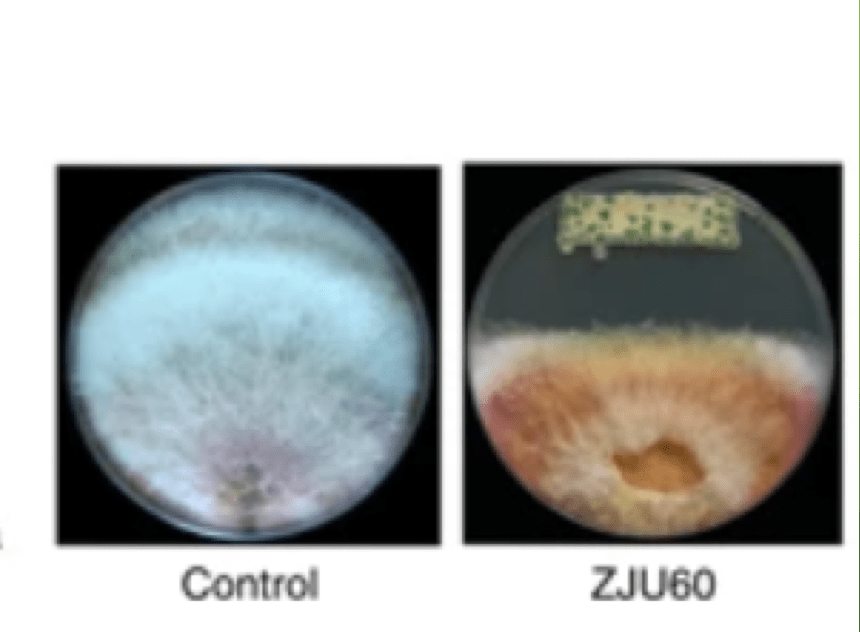
12,854 culturable bacteria were obtained from the infected wheat heads and examined for antagonistic activity to the fungus in vitro. A bacterial isolate deemed ZJU60 showed the strongest inhibitory activity against the fungus producing a radius inhibition zone >20mm. As shown in figure 1.
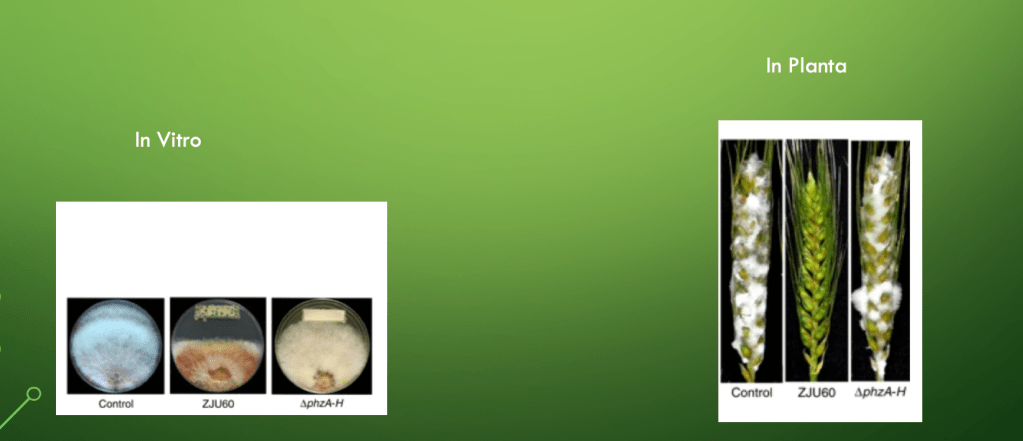
To determine if ZJU60 inhibited the growth of the fungus in planta, wheat heads were Inoculated with ZJU60 both in a growth chamber and in the field. Under both conditions the fungus infection was significantly supressed. Mycotoxin was also significantly reduced under both conditions. (Refer to figure 1,2 and 3 in question 4)
To determine how the ZJU60 bacteria was inhibiting the fungus, a complete sequence of its genome was done using pac bio 2. Bioinformatic analysis then showed that ZJU60 had the genes encoding for 4 antifungal secondary metabolites. Hydrogen cyanide, phenazine, pyoverdine and achromobactin.
To identify which antifungal compounds were involved in supressing the fungus, deletion mutants of the individual operons involved in the biosynthesis of each antifungal compound were constructed, and the antifungal activity was examined both in vitro and in planta. Disruption of the phzA H operon, which is responsible for the biosynthesis of phenazine compounds, resulted in complete loss of antifungal activity both in vitro and in planta. As shown here. The antifungal activity of the other mutants was no different, suggesting that phenazine compoudns produced by ZJU60 bacteria may be critical to its antifungal activity. (Refer to figure 2)
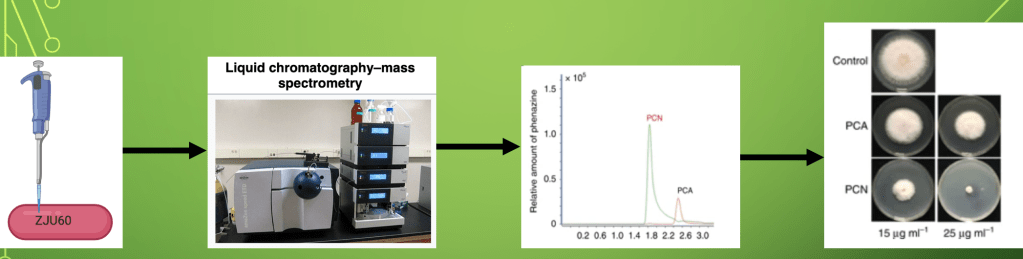
To further confirm the production of phenazine compounds by ZJU60 extraction and identification using liquid chromatographic-mass spectrometry was used. This revealed that the major phenazine compound produced was PCN followed by phenazine-1-carboxylic acid. The growth inhibitory activities of both these compounds was examined in vitro. The fungus grown with PCN had significantly less growth than when it was grown with PCA. As shown in figure 3. This suggests that PCN is the major antifungal compound produced by ZJU60.
However, the mechanism by which PCN inhibited fusarium gramarium growth remained unknown. Therefore, the PCN sensitivity of 1100 fusarium gramarium deletion mutants was examined. The proteins encoded for in the mutants each had various crucial biological functions including protein kinases and transcription factors. Of all the mutants only 1 mutant FgSG_06291 showed increased sensitivity to PCN so they remained this the FgPCN gene.
Bioinformatic analysis showed that the FgPCN gene was homologous to a the SPT7 gene in another fungi and in this fungi the gene is responsible for encoding a transcriptional activator subunit in the SAGA complex of fungi. The SAGA complex is the largest histone acetyl transferase complex of fungi consisting of 19 subunits. Further mutant studies and biochemical analysis highlighted that PCN directly targets the FgGcn5 protein of the complex and subsequently inhibits HAT activity. When this activity is inhibited fungal virulence and mycotoxin production is supressed.
Therefore, the secondary metabolite PCN produced by the ZJU60 bacteria directly inhibits histone acetylation transferase in the SAGA complex of the fungus responsible for fusarium head blight
 Plant microbiome